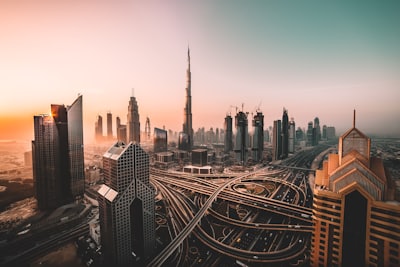
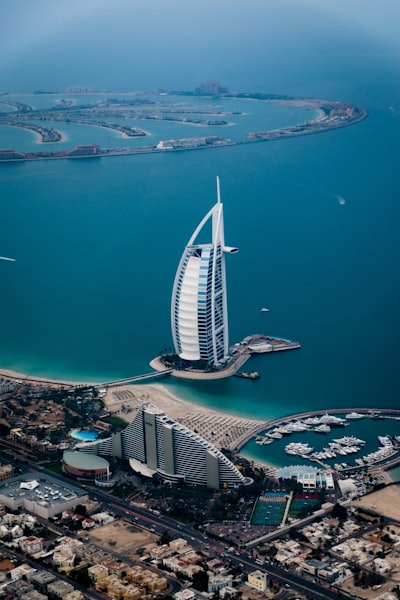
As ceasefire talks between Iran and the United States progress in 2026, property investors with exposure to Dubai, or those considering it, are asking a natural question: what does a reduction in regional tensions mean for the Dubai property market? The answer is more nuanced than most commentary suggests, and ultimately more positive for investors than pessimists assume.
We covered the impact of the initial Iran conflict on Dubai property in an earlier article. Now, as the geopolitical picture evolves, it's worth examining what a more stable regional environment means for the market going forward.
What the Ceasefire Talks Mean, and What They Don't
First, the context. Ceasefire negotiations involve complex parties and rarely produce immediate or permanent resolutions. The significance for Dubai investors is not whether a deal is signed tomorrow, it is the directional shift in regional risk that the talks themselves represent. Markets price in probability, not certainty, and the probability of a major regional conflict directly involving the UAE has clearly reduced.
Key context: Throughout the period of peak regional tension in 2025-2026, Dubai's property market continued to record transaction volumes at or near all-time highs. This is not an accident, it reflects the structural insulation Dubai has built through decades of diplomatic neutrality, physical distance from conflict zones and an economy built on trade, tourism and financial services rather than resource extraction.
How Regional Stability Affects Dubai Property
Tourism and short-term rental demand increases
Dubai's short-term rental market is heavily influenced by regional and international tourism. During periods of heightened tension, some travellers from Europe and Asia reroute away from the region entirely. As ceasefire talks progress and regional stability improves, tourism rebounds, and with it, the occupancy rates and nightly rates that drive short-term rental returns for Dubai property investors.
Iranian capital flows into Dubai increase
This is one of the most significant and least-discussed dynamics in the Dubai property market. Iran has historically been one of the largest sources of foreign capital into Dubai real estate, wealthy Iranian families and businesses have long used Dubai as a safe haven for assets. Periods of tension reduce these flows as sanctions and banking restrictions tighten. Progress toward a diplomatic resolution could materially increase Iranian capital flowing into Dubai property, adding a new layer of demand to an already supply-constrained market.
Regional business investment accelerates
Dubai has positioned itself as the operational headquarters for businesses serving the broader Middle East and North Africa region. When regional stability improves, multinationals expand their Dubai operations, corporate tenant demand for Grade A apartments and villas increases and the premium end of the rental market strengthens. This directly benefits investors in communities like Downtown Dubai, DIFC-adjacent Business Bay and Dubai Marina.
New investor confidence from global markets
Institutional and high-net-worth investors from Europe, Asia and North America apply risk premia to Dubai investments during periods of regional instability, even when Dubai itself is unthreatened. As that risk premium reduces, new capital enters the market. This is already visible in transaction data from early 2026, which shows renewed interest from European family offices and Asian sovereign wealth vehicles in Dubai's ultra-luxury segment.
The Two Scenarios, and What Each Means for Your Investment
Scenario A: Ceasefire Holds
Tourism rebounds strongly. Iranian capital flows increase materially. Regional business expansion accelerates. New international capital enters the market with reduced risk premium. Dubai property prices and yields benefit from increased demand across all segments. Investors who entered during the uncertainty period benefit from appreciation as the risk premium unwinds.
Scenario B: Talks Collapse
Tensions resume at previous levels. Dubai continues performing as it has throughout the conflict period, recording near-record transaction volumes and maintaining rental yields of 6-9%. The market's structural insulation remains intact. Investors are no worse off than they were before the talks began, in a market that has consistently delivered through every geopolitical cycle.
The asymmetry here is notable. In Scenario A, investors benefit from upside. In Scenario B, the market continues performing as it already has through a period that most external commentators described as high-risk. Both outcomes are positive for Dubai property holders.
"Dubai has delivered through every geopolitical cycle of the past three decades. The case for the market does not rest on regional peace, it is strengthened by it."
What This Means for Off Plan Property Specifically
Off plan investors in Dubai have a particular advantage in this environment. Because you are buying a property that completes in 2027-2031, you are not exposed to today's geopolitical uncertainty in the way a buyer of ready property is. By the time your development completes, the regional picture will have had years to evolve, and on the current trajectory, that evolution is toward stability, not escalation.
The combination of buying at launch pricing, paying in instalments during construction, and completing into a potentially more stable regional environment is a compelling investment structure. The downside is protected by RERA regulation and escrow accounts. The upside is driven by Dubai's structural fundamentals, population growth, infrastructure investment, zero taxes and a government committed to making the emirate the world's leading global city.
Our Investment Verdict
Progress toward regional stability is unambiguously positive for Dubai property investors, it removes a risk premium that was suppressing returns without ever materialising into actual damage to the market. For investors who have been waiting on the sidelines until the geopolitical picture clarified, the direction of travel now strongly favours acting rather than waiting further.
The window between uncertainty and certainty is historically when the best returns in Dubai property have been made. Investors who bought during the 2020 pandemic, the 2014-15 oil price crash and the 2009 global financial crisis all captured the strongest appreciation as conditions normalised. The current environment presents a similar entry point.
Speak to Our Team
Our specialists can walk you through current off plan opportunities in Dubai, compare payment plans and help you identify the right entry point for your budget and goals. Completely free.
Book a Free Consultation